
Parabolic Microphone Focus: Various simulated scenarios

19.07.26 08:46 PM By John Harrison

Every parabolic dish concentrates on-axis sound towards the microphone. Put the capsule there and everything the dish gathered arrives in phase. Miss it, and the arrivals from different parts of the dish stop agreeing with each other - first at the highest frequencies, where a millimetre is a bigger fraction of the wavelength.

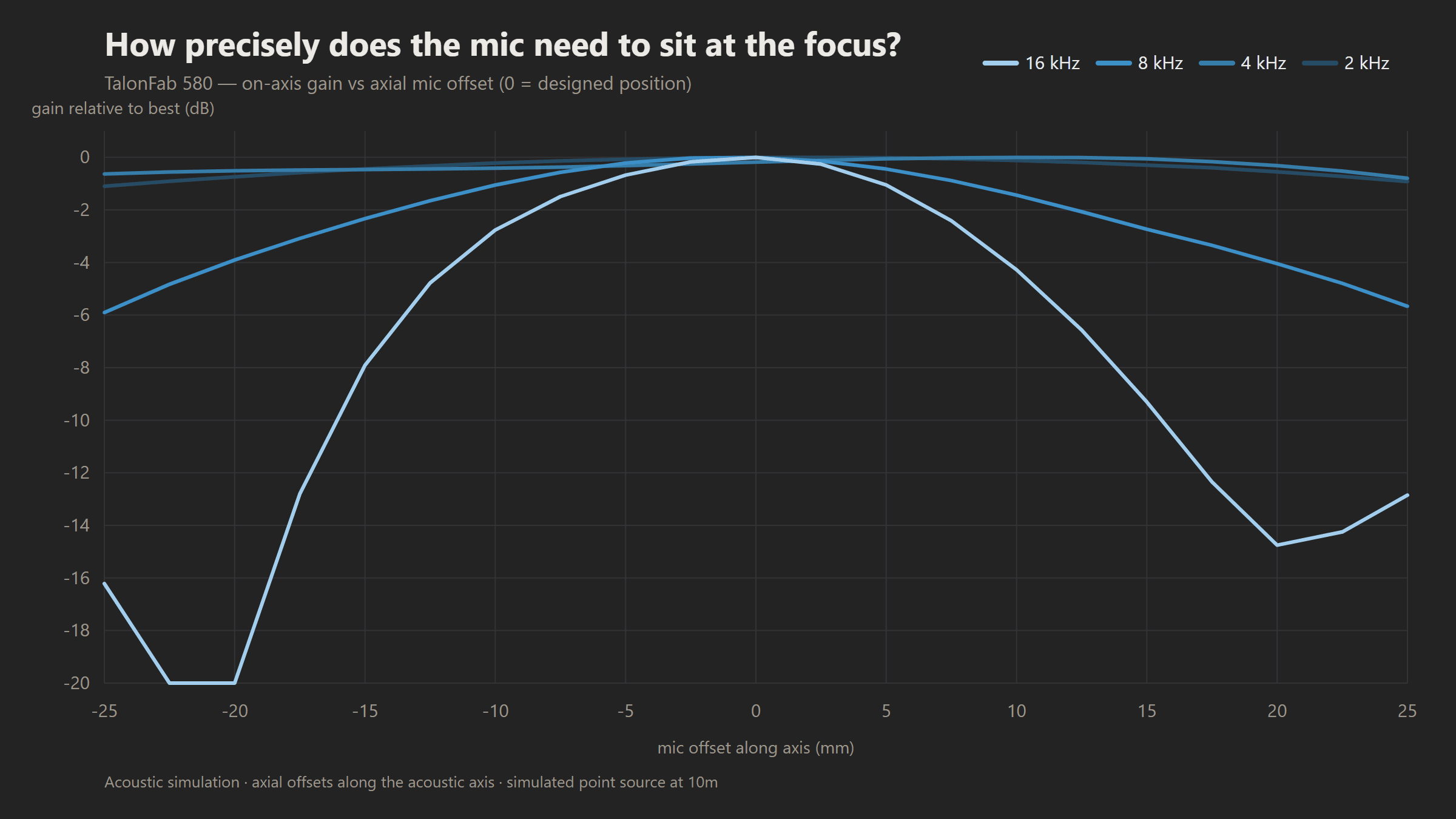
We wanted to know exactly what missing it costs and validate our designs ahead of printing prototypes, so as part of developing our microphones we ran simulations with varying microphone position along their axes in simulation and track the on-axis gain at 2, 4, 8 and 16 kHz. This is what it looks like for the prototype Parabolic Microphone 580:

Source Distance Moves the Focus

A parabolic dish’s textbook focal point assumes the incoming sound waves are effectively flat. That is a good approximation for a distant bird, but not for a sound source only a couple of metres away. A nearby point source produces a noticeably curved wavefront, which changes where the reflected sound comes together. The graph above is produced with a source at 10 meters - not infinitely far away.


We simulated the TalonFab 580 at 8 kHz with point sources placed 2, 5, 10, 25 and 100 metres away. At 5 and 10 metres, the best microphone position was the designed position. At 25 and 100 metres, the simulated optimum shifted only about 2.5 mm towards the dish with a tiny loss in gain - too little to matter in practice.

imulated microphone focus offset for the TalonFab 580 at 8 kHz with sources from 2 to 100 metres away
Simulated microphone focus offset for the TalonFab 580 at 8 kHz with sources from 2 to 100 metres away. Each curve in the graph is normalised to it's own maximum. It shows how source distance changes the best capsule position, not how much quieter a bird becomes as it moves away.

The 2 metre source was different. Its optimum moved about 20 mm away from the dish, towards the source. This is the near-field effect made visible: the closer the source, the more curved its wavefront, and the further forward the reflected sound reaches its best focus. This matches intuition - parabolic microphones are not especially useful for very close subjects.

Across the distances where a parabolic microphone normally earns its keep, the current fixed position remains comfortably inside the broad 1 dB tolerance region. At 2 metres, moving the capsule could recover some 8 kHz gain, but at that distance the signal to noise ratio of the call is probably already very good and a parabolic microphone is of limited benefit. Still, it does mean it's a good idea to reduce the amount of equalisation for very close subjects which is one of the reasons the frequency response compensation in TalonFab Recorder and Editor has adjustable strength.

What happens if your parabolic dish is distorted?

The whole sweep from above assumes the dish is actually the shape it's meant to be. A printed dish is very close: it comes off the machine as its CAD surface and holds that curve to under a millimetre.

A thin dish thermoformed or moulded from sheet is a harder case because those manufacturing processes are not as precise without additional quality control steps - mould wear, the change in shape during cooling and over the dish lifetime is more difficult to manage.

We simulated that too the same 580 mm dish, but warped out of shape by up to 2 and 4 mm, with the capsule sitting at the design focus in every case.
Gain lost to simulated thermoform distortion
Through most of the band the three curves sit on top of each other. Distortion only bites at the very top: 2 mm of warp costs about half a decibel at 16 kHz and essentially nothing below 8 kHz, while 4 mm costs about 2 dB at 16 kHz, half a decibel at 8 kHz, and still almost nothing across the core 1-4 kHz range where most birds live. So for gain alone, a few millimetres of distortion is a top-octave problem - it trims the sparkle, not the substance. We'd rather show that plainly than pretend a warped dish is useless. It isn't.

Another subtle cost is the one this article is about: the focus. An oval dish isn't a paraboloid any more - it's steeper across its short axis than its long one, so the two directions focus at slightly different points along the axis. There's no longer a single sharp focus to sit the capsule at; you're splitting the difference between two. And a dish that's warped, or a touch too deep or too shallow, moves its focus bodily along the axis.

We can watch that happen. Here is the same 580 mm dish, ideal versus warped by 4 mm, with the capsule swept along the axis:
On-axis gain vs capsule offset, ideal dish vs a 4 mm warp
At 8 kHz (dashed) the warp barely registers - both curves stay within half a decibel of each other across a broad, forgiving range. At 16 kHz (solid) it shows: the ideal dish still comes to a clean peak, while the warped dish sits about 2 dB lower with its top flattened into a plateau. There's no single sharp position to aim for, because its horizontal and vertical planes now focus at different points. The best spot to focus has changed and could be adjusted for, but wherever you park the capsule, something is slighty out. That's the top-octave sparkle going a little soft.

None of this is a fixed error you could design a mount around, because the size and direction change from one part to the next - which is exactly why some dishes made this way tend to come with a mount you can adjust.

What happens across different temperatures?

A parabolic dish does not stay exactly the same size as its temperature changes. Like any polymer part, it contracts in cold weather and expands when it gets warm. The useful question is whether that movement is large enough to change the dish’s focus or affect its performance.

We modelled a 580 mm dish between −10 and 40 °C, using 20 °C as the reference temperature. The first case represents a typical polycarbonate dish. At −10 °C its predicted diameter is about 1.22 mm smaller than at room temperature. At 40 °C it is about 0.81 mm larger, giving a little over 2 mm of movement across the full temperature range. Because the entire parabola scales with the diameter, its focal distance changes as well. For a nominal focal length of 203 mm, the polycarbonate model moves from about 0.43 mm shorter at −10 °C to 0.28 mm longer at 40 °C. The total focal movement across the temperature range is about 0.71 mm.

The ASA-CF model performs a lot better - the carbon fibres significantly reduce the amount of thermal expansion. Its predicted diameter changes by about 0.21 mm below the room-temperature value at −10 °C and 0.14 mm above it at 40 °C. That is roughly 0.35 mm across the complete 50-degree temperature swing. Its corresponding focal-distance movement is about 0.12 mm from one extreme to the other.
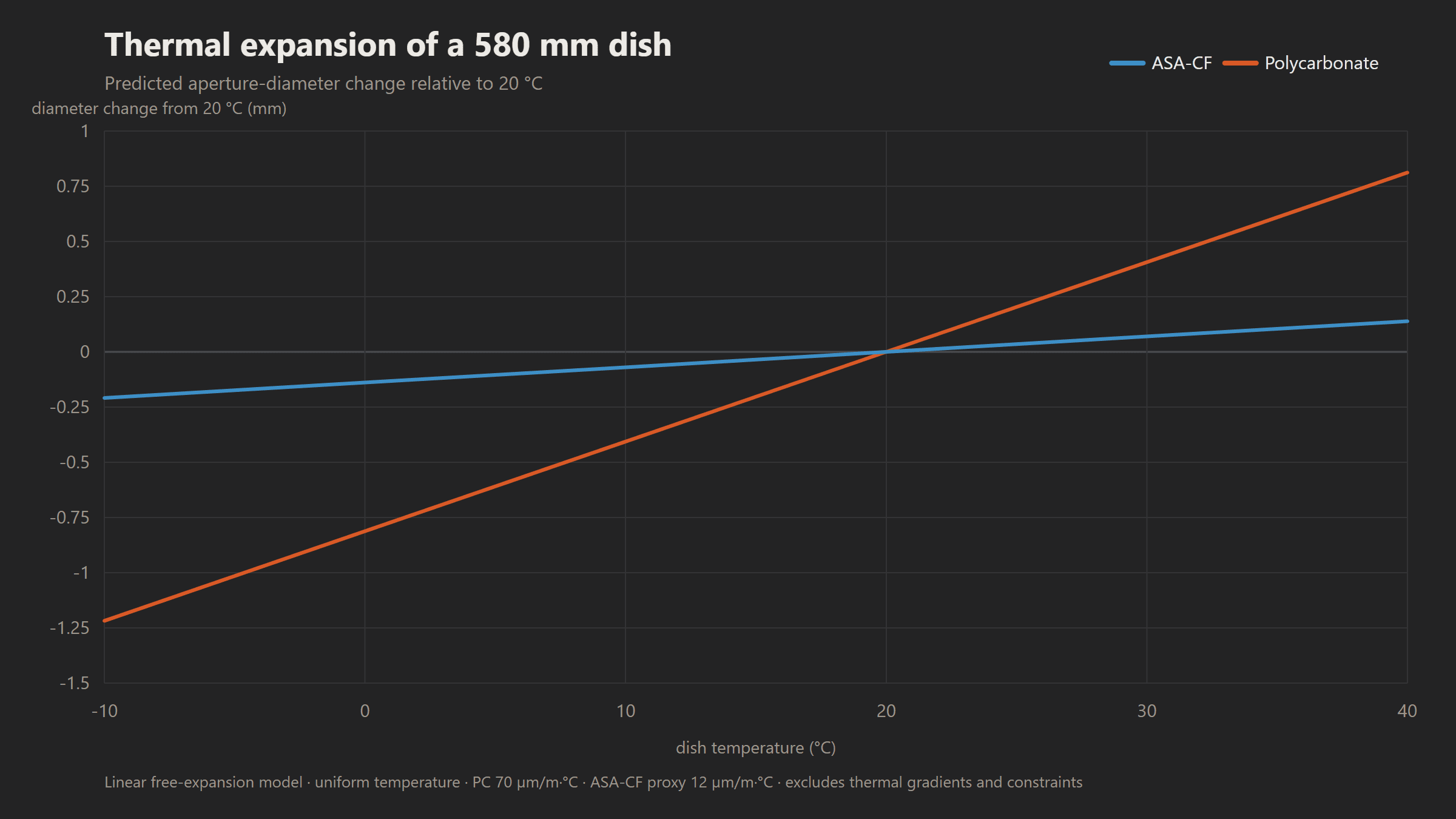
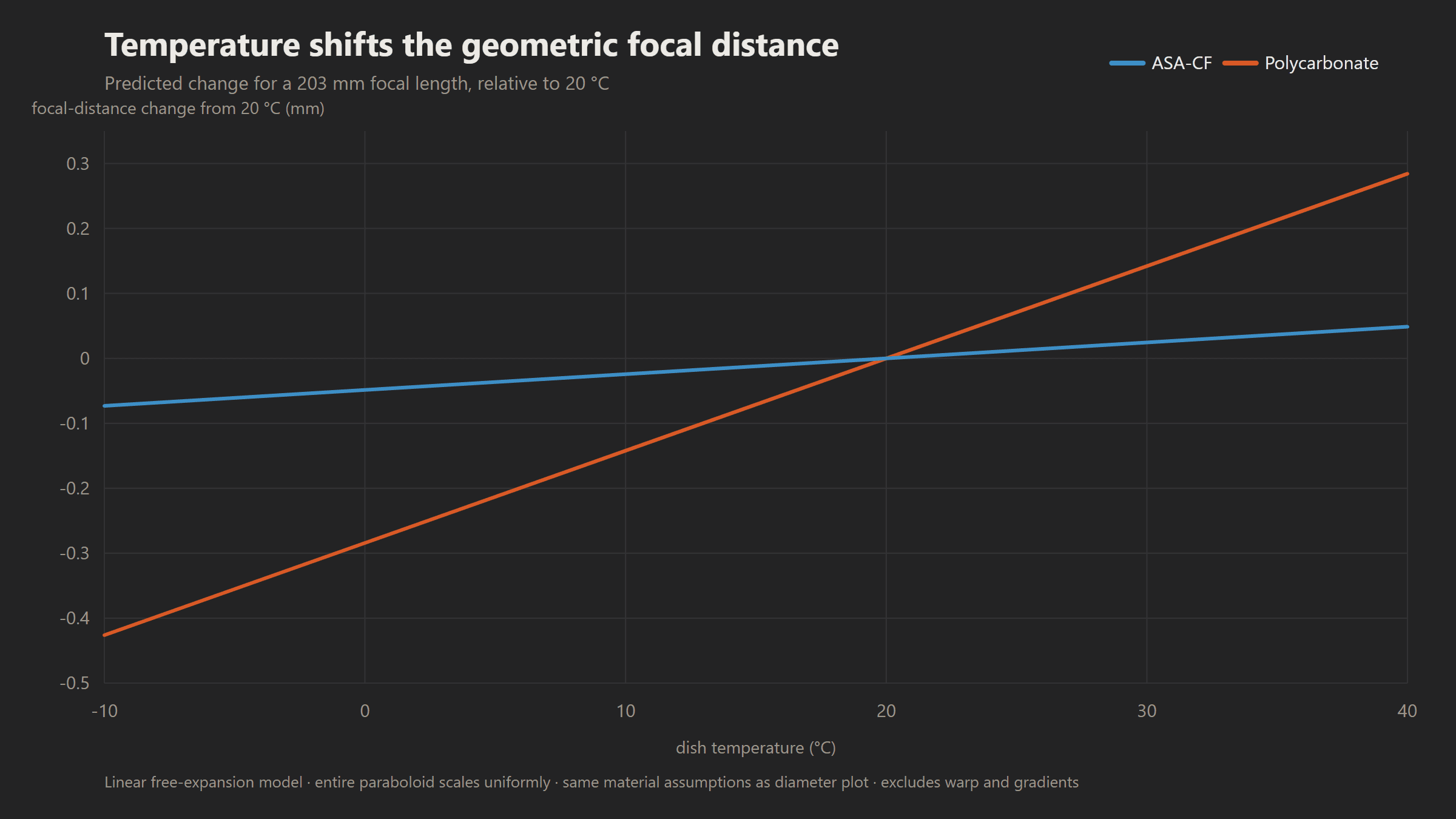
Despite ASA-CF's superior performance, it doesn't really matter in practise. Even with polycarbonate a change of focal length of 0.71mm would be insignificant to the point of being inaudible, and, at least for TalonFab products, the microphone mount is made of the same material - so it tends to expand to compensate.

Uneven temperature is another possibility - part of a dish left in the sun in the car for example. We didn't simulate this situation as in practise it would be similar to the dish warp scenario we looked at above.

Why TalonFab mounts are fixed
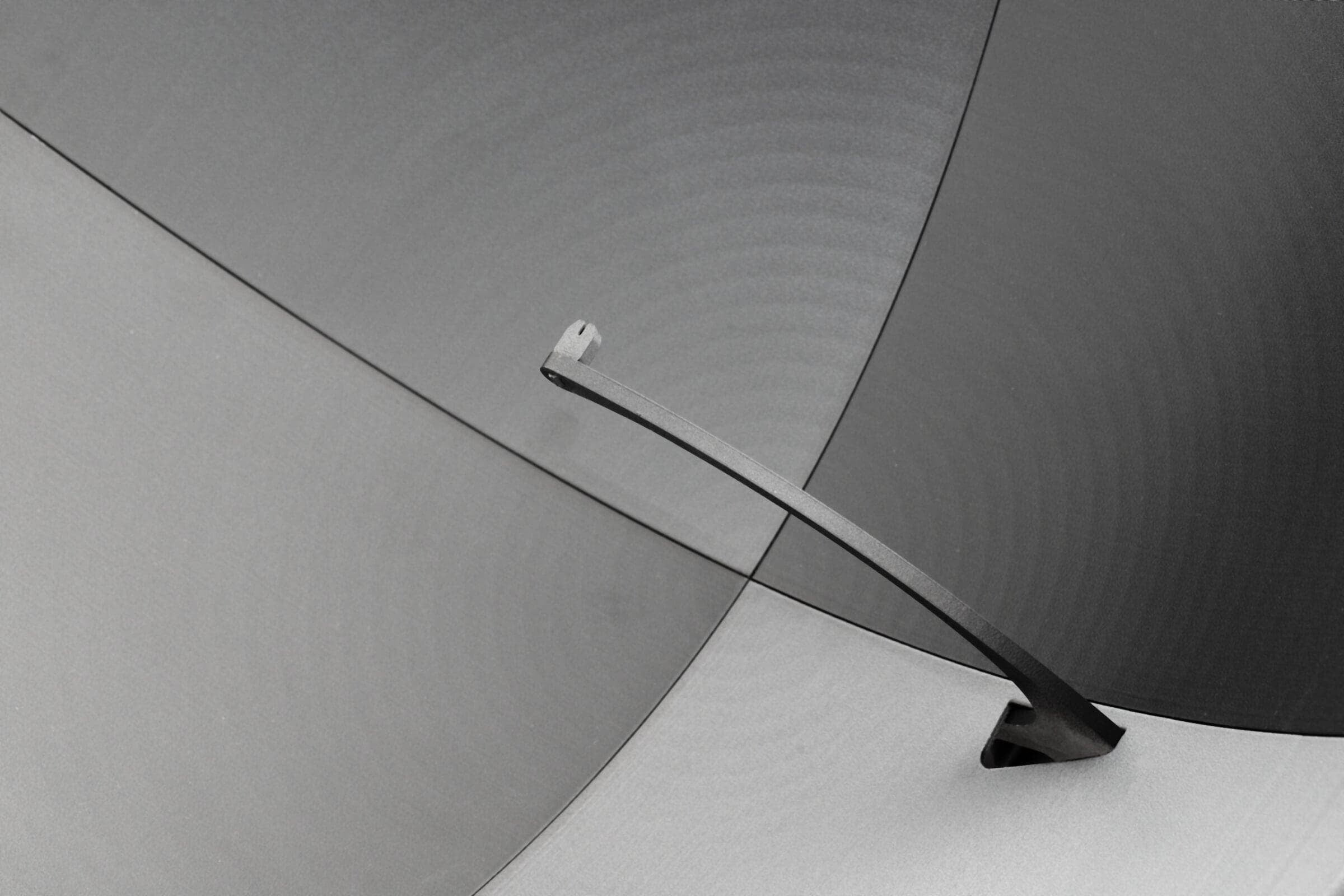
This data is the reason TalonFab mounts have nothing to adjust.

A printed dish comes off the machine as the CAD surface - we hold the produced geometry with millimeter precision and accuracy for known microphones, so the focal behaviour is known before the validation in prototyping. The dish, arm and capsule seat print as one rigid assembly in carbon-fibre reinforced ASA, a stiff filament chosen so the geometry stays put through handling and temperature swings. The capsule is placed at design position every time: on the 580 that's comfortably inside the 1 dB window at every frequency we publish, 16 kHz included and it's similar for the 300.
The fixed mount on the TalonFab 580 Parabolic Microphone
Adjustable mounts exist for a sensible reason - they're the rational choice for universal dishes, where one reflector has to accept whatever microphone you clamp into it. They're also rational for dishes that may have larger local deviations or ovality due to looser tolerances in the manufacturing process or where they are made from a thin or flexible material.

Different capsules put their diaphragms in different places and actual focal lengths vary with tooling, so a sliding boom and a thumb screw let the user hunt for the focus by ear. It can work fine. The failure mode is also obvious from the plots: "by ear, in the field, with cold fingers" is how you end up parked 20 mm from focus wondering where the top octave went. If you use an adjustable dish, our advice is to align it once at home against a distant, constant sound source at 6-8 kHz where the plots are sharpest - then mark the position and never touch it again.

One honest caveat: a fixed mount is fixed for the microphones it was designed around. TalonFab mounts position the capsule of the Røde Lavalier GO and the Deity W.Lav Pro - and that known-capsule focus is the price of never fiddling. We think it's the right trade for a field tool - the same philosophy as carrying a prime lens instead of a zoom.

Final Thoughts

Focus tolerance is real but finite: for a big dish a few millimetres is free, 20 mm costs lost gain in the top octave. Design the mount so the capsule can't be anywhere else and the whole question disappears from your field workflow - one less thing to get wrong early in the morning!

John Harrison

TalonFab

Items have been added to cart.
One or more items could not be added to cart due to certain restrictions.
Added to cart
Your cart has item(s).
- Can't add this product to the cart now. Please try again later.
Quantity updated
- An error occurred. Please try again later.
Deleted from cart
- Can't delete this product from the cart at the moment. Please try again later.